
A tennis serve, badminton smash or squash drive may appear to come primarily from the hitting arm. In reality, racket speed depends on coordinated force travelling from the ground through the legs, pelvis, trunk, shoulder and arm. When that sequence loses timing, the arm may attempt to create speed on its own.
Training through reformer pilates Singapore can help racket-sport players practise rotation, anti-rotation and force transfer under adjustable resistance. The reformer does not recreate the speed or decision-making of a rally. Its value lies in slowing selected components so athletes can build control before returning them to sport-specific movement.
Rotation Is a Whole-Body Skill
The trunk rotates between the pelvis and shoulders, but the movement begins with ground contact. Legs create and redirect force, the hips contribute, and the torso transfers energy towards the racket arm.
Different racket sports use this chain in different ways. Tennis serves involve substantial lower-body drive and trunk rotation. Badminton requires rapid overhead actions, lunges and recovery steps. Squash adds repeated low positions and changes of direction in a confined court.
A generic twisting exercise cannot address every demand. Training should reflect the athlete’s sport, side dominance, injury history and competition schedule.
Rotation and Anti-Rotation Belong Together
Athletes need to produce rotation, but they also need to control unwanted movement. Anti-rotation describes the ability to resist a force that attempts to turn the body.
On the reformer, a single strap can pull the torso towards one side. The athlete maintains an organised position while the arm moves. This develops control without requiring complete rigidity.
Anti-rotation work is not intended to eliminate trunk movement from sport. It builds the ability to decide when and where rotation occurs.
Why the Reformer Offers Useful Feedback
The carriage shows whether force is smooth. If an athlete jerks through a movement or shifts asymmetrically, carriage speed and strap tension may change. This feedback is immediate without requiring a complex sensor.
Springs also provide a clear direction of resistance. The athlete can practise initiating movement from the hips and trunk rather than pulling only with the arm.
Because the resistance is adjustable, the exercise can begin slowly. Speed should increase only after the athlete controls the path and return.
Key Movement Qualities for Racket Athletes
Hip and Leg Force
Footwork, split-stance presses and carefully selected standing exercises can strengthen the lower body. The goal is stable pressure through the foot and coordinated hip and knee movement.
Trunk Rotation
Seated, kneeling or standing strap variations can train controlled rotation. The pelvis may remain relatively stable in one drill and contribute in another, depending on the objective.
Anti-Rotation
Unilateral arm work asks the trunk to resist the spring’s pull. This can help athletes organise the ribs and pelvis while the shoulder moves.
Scapular and Shoulder Control
Rows, presses and overhead strap patterns can train the shoulder blade and arm under resistance. Range must remain comfortable, particularly for players with a history of shoulder symptoms.
Deceleration
The return phase of a reformer exercise trains braking. Racket sports require the body to slow the arm and trunk after high-speed strokes and prepare for the next movement.
A Progressive Reformer Sequence
1. Bilateral Footwork
Begin with both feet on the footbar. Press the carriage out smoothly and control the return. Observe left-to-right pressure and avoid allowing one hip to lead.
2. Single-Leg Footwork
Progress to one leg only if the athlete maintains pelvic control. The spring setting may need adjustment because one limb now manages a larger relative load.
3. Half-Kneeling Anti-Rotation
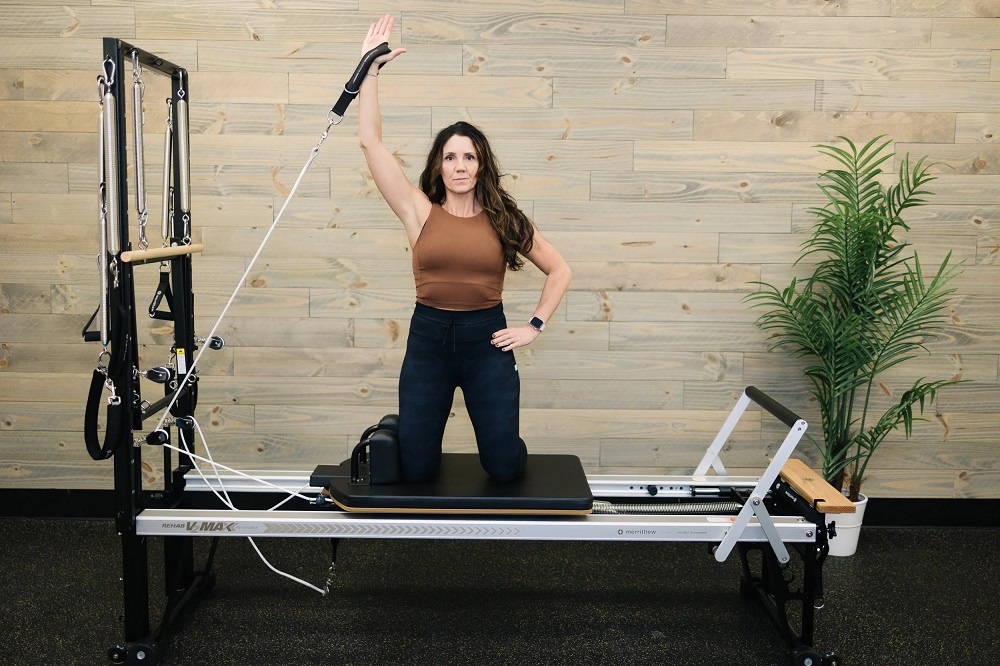
With one knee supported and a strap held in the outside hand, maintain the trunk position while pressing or pulling. The carriage should move predictably without the athlete leaning away from the spring.
4. Controlled Rotational Pull
Allow a small trunk rotation while drawing the strap across the body. Initiate from the torso rather than yanking with the arm. Return slowly.
5. Standing Split-Stance Control
Use a stable split stance with suitable carriage support. Practise a small weight shift and controlled return. This connects trunk work with the legs while keeping speed low.
The sequence is an example, not a universal prescription. Exercise selection and spring settings require individual adjustment.
Train Both Sides Without Chasing Symmetry
Racket sports are inherently asymmetrical. The dominant side performs more skilled and forceful strokes. Training both sides can expand movement options, but the goal is not to make every measurement identical.
Compare control, range and confidence. A large difference may inform programming, yet it does not diagnose an injury. Fatigue and unfamiliarity can influence the non-dominant side.
The athlete may perform equal volume initially or use small targeted adjustments based on coaching and clinical input. Excessive extra work on one side can create new fatigue.
Tempo Before Speed
The reformer is well suited to controlled tempo. Athletes can feel how force develops and where the carriage changes speed. Slow training alone, however, does not prepare someone fully for a fast rally.
Once technique is consistent, selected exercises may use a quicker but still controlled concentric phase followed by a deliberate return. The equipment must never slam into the stopper.
High-speed, reactive and sport-specific work belongs on court or in appropriate strength and conditioning sessions. The reformer supports the foundation rather than replacing those environments.
Place Reformer Work Within the Training Week
A heavy lower-body reformer session may affect court movement the next day. An intense shoulder session may influence serving. Schedule needs to reflect practices, matches and other strength work.
During competition periods, maintain familiar movements and moderate volume. The off-season can support more progression and exploration.
Recovery-focused sessions may use lighter perceived effort and smaller ranges. They should leave the athlete prepared rather than sore.
Avoid Common Rotational Errors
Do not use excessive spring resistance that forces the athlete to lean or pull primarily with the arm. Do not lock the pelvis in every exercise, because sport requires coordinated movement across multiple segments.
Avoid maximum rotation under fatigue. Range should remain controllable, and the carriage path should be repeatable.
Breath holding may signal excessive effort. Breathing does not need to follow a rigid pattern, but it should remain available.
Measure Transfer Carefully
Improvement on the reformer does not automatically mean a faster serve or more accurate smash. Sport performance also depends on technique, timing, perception, racket skill and tactical decisions.
Useful intermediate measures include smoother unilateral control, improved ability to decelerate the carriage and greater confidence rotating through a comfortable range. Court coaches can then assess whether these qualities transfer.
At Yoga Edition, racket-sport athletes can learn spring selection and exercise progressions with instructor oversight. The most effective programme remains coordinated with technical coaching, competition load and any rehabilitation plan.
When Pain Changes the Plan
Persistent back, hip, elbow or shoulder pain should not be trained through simply because the reformer feels low impact. Radiating symptoms, weakness, numbness, acute swelling or pain after trauma require appropriate assessment.
Return-to-sport decisions belong with qualified healthcare and coaching professionals. A reformer instructor can adapt training but should not diagnose an injury.
Conclusion
Rotational control involves generating force, transferring it through the trunk and slowing it after the stroke. The reformer can isolate these qualities under adjustable resistance and visible carriage feedback.
It works best as part of a wider performance plan. Controlled reformer exercises build options, while court practice develops the speed, timing and decisions that racket sport ultimately demands.
Frequently Asked Questions
Can reformer training increase racket speed?
It may improve supporting qualities such as strength and control, but racket speed also depends on technique, timing and sport-specific practice.
Should players train only their dominant side?
No. Both sides benefit from training, although sport-specific asymmetry is normal. Volume should reflect individual needs rather than forced equality.
Is anti-rotation training the same as keeping the trunk rigid?
No. It teaches the athlete to manage an external rotational force. Sport still requires well-timed trunk movement.
Should reformer work be done before a match?
Avoid unfamiliar or fatiguing sessions immediately before competition. A short familiar activation may suit some athletes when coordinated with their coach.
Which spring setting is best for rotational work?
There is no universal setting. Resistance should allow a controlled carriage path without leaning, jerking or losing the intended trunk position.
Can the reformer rehabilitate a shoulder injury?
It may be used within a professionally designed rehabilitation plan, but it does not diagnose or independently treat an injury. Seek qualified clinical guidance.