
53
Watch a gym full of nine-year-olds playing pick-up basketball, and you will almost certainly see an unruly swarm of sneakers chasing a rolling ball, punctuated by awkward, off-balance heaves toward the rim. It is an understandable sight. Young athletes naturally want to emulate the step-back three-pointers and acrobatic finishes they watch on highlight reels. Yet basketball mastery is not built from the perimeter backward; it is constructed from the ground up through deliberate, repeated motor patterns that teach balance, spatial recognition, and composure under pressure.
For coaches and trainers, the primary objective during developmental years is not executing complex offensive schemes. It is developing players who are fundamentally comfortable in their own bodies and capable of processing the floor while manipulating the basketball. Structuring a youth curriculum around essential, battle-tested drills bridges the gap between chaotic running and disciplined, intuitive play.
Building Floor Vision Through Ball Handling
A player who must stare at the ball to control it is playing basketball with one eye closed. They cannot spot an open teammate cutting along the baseline, nor can they anticipate a help defender stepping up to strip the rock. Effective ball-handling drills for young athletes must decouple hand mechanics from visual dependency as early as possible.
Visual Cue Dribble Series
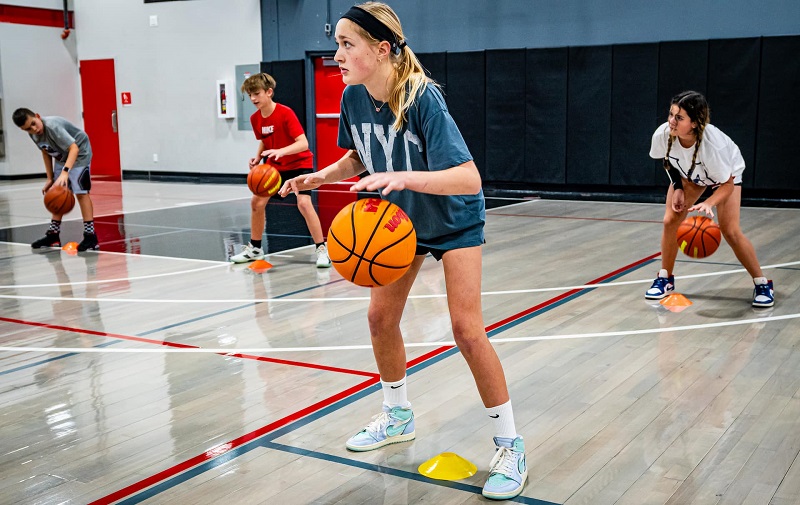
Stationary dribbling is often derided as tedious, but it remains the most direct way to build hand strength and finger-pad sensitivity. To keep players engaged and force their eyes off the leather, integrate visual prompts. Have players adopt an athletic stance—knees bent, chest upright, and chin raised—while pounding the basketball at knee height with their dominant hand. Stand several feet in front of them, flashing random numbers with your fingers or holding up colored cones.
The player must call out the number or color the instant it appears, without losing their dribble cadence. Progress this drill from a single hand to a low crossover, between the legs, and behind the back. By demanding simultaneous cognitive recognition and mechanical control, the drill conditions the brain to treat dribbling as an automated background process rather than an active visual task.
Two-Ball Synchronous and Alternating Pounds
Nothing exposes a weak off-hand faster than a two-ball drill. Handing a young player two basketballs eliminates their security blanket, forcing their non-dominant hand to generate identical force and control.
Begin with synchronous pounds, where both basketballs hit the hardwood at the exact same moment at waist height. Once rhythm is established, transition to alternating dribbles, mimicking a rapid piston motion. After mastering stationary execution, have the players walk the length of the court while maintaining the dribble against light defensive harassment. The goal here is not showmanship; it is developing balanced neurological coordination so that driving left feels just as instinctive as driving right.
Footwork Mechanics and Finishing at the Rim
Most missed layups at the youth level are not caused by bad hands; they are caused by uncontrolled feet. Young players frequently gather the ball too early, leap from awkward angles, or sprint toward the backboard with so much forward momentum that a soft touch becomes impossible.
The Classic Mikan Drill and Reverse Variations
Named after basketball pioneer George Mikan, this drill remains the undisputed gold standard for cultivating touch around the basket. Position the player directly under the hoop, angled slightly toward the right block. Using a controlled one-two step, the player jumps off the left foot, protects the ball high, and lays it off the top corner of the backboard using the right hand. As the ball drops through the net, the player grabs it before it touches the floor, takes a crossover step to the left side, and repeats the movement with their left hand off the right foot.
Demand that players keep the ball above shoulder level throughout the sequence to discourage the habit of dipping the ball into traffic where guards can strip it. Once players establish a steady cadence with traditional layups, introduce the reverse Mikan. This variation forces them to finish along the baseline side of the rim, teaching them how to use the backboard as a protective shield against shot-blockers.
The Jump Stop and Triple-Threat Pivot
Traveling calls disrupt youth games more than almost any other rule infraction. Teaching players how to decelerate into a balanced two-foot jump stop resolves this problem immediately.
Set up cones at the wings and top of the key. Players attack the cone with two aggressive dribbles, execute a controlled jump stop on two feet, and immediately sink into a balanced triple-threat stance. From that position, direct them through front pivots and reverse pivots without lifting their established pivot foot. Emphasize keeping elbows wide and sweeping the ball low across the shins—the classic rip-through—to protect against aggressive reaching. Mastering this footwork instills physical poise, turning panicked ball-stoppers into patient decision-makers.
Shooting Development from the Inside Out
Young players routinely attempt shots from distances their current physical strength cannot support. To push the ball to the rim from the three-point line, a ten-year-old inevitably twists their torso, drops the ball below their waist, or kicks their legs outward to generate momentum. This creates erratic shooting mechanics that become painfully difficult to unlearn later in life.
Form Shooting from Close Range
Effective shooting instruction starts within three to five feet of the basket. Have the player stand squarely in front of the rim with their shooting foot slightly ahead of their non-shooting foot. Instruct them to bring the ball directly up into their shot pocket, creating a clean ninety-degree angle at the elbow and wrist.
Initially, run this drill with one hand, removing the guide hand entirely. The player dips slightly, extends upward in a fluid, single-motion release, and holds their follow-through with their wrist relaxed over the front of the rim. Because they are close to the basket, they do not need to heave; they can focus entirely on backspin, arc, and clean rotation. Only when a player can consistently swish eight out of ten shots with pure form should they take a step back or introduce a light, passive guide hand to the side of the ball.
Catch-and-Shoot Relocation
Shooting off the catch introduces timing and momentum. In this drill, the player begins on the wing, passes the ball out to a coach at the top of the key, and cuts toward the elbow or baseline. As the pass returns to them, they must drop into an athletic base, catching the ball on either a quick one-two step or a hop, depending on their natural rhythm.
The emphasis is on shot preparation: dipping the hips before the catch rather than after, locking the eyes onto the target, and maintaining vertical balance on the rise. A great shooter prepares their feet before the ball ever touches their fingertips.
Individual and Help-Side Defensive Fundamentals
Scoring points gets the glory, but defensive competency earns playing time. Youth defense frequently suffers because players are taught to chase the basketball rather than anticipate space. Teaching solid defensive positioning instills discipline, teamwork, and high basketball IQ.
The Zig-Zag Slide and Drop-Step Drill
Great defenders do not sprint forward to stop a drive; they slide laterally and beat the offensive player to the spot. Use the full length of the court, utilizing the space between the sideline and the key.
The defender starts in a deep stance: feet wider than shoulder-width, chest up, hips low, and active hands mimicking a wide wingspan. As an offensive ball-handler zig-zags down the court, the defender pushes off the back foot to slide laterally. When the offensive player changes direction, the defender drops their lead foot back, opens their hips, and redirects their slide without crossing their feet. Emphasize lateral agility and disciplined feet rather than swiping at the ball, which inevitably leads to cheap reaching fouls.
The Shell Drill for Team Defense
Individual containment matters, but basketball is played five-on-five. The four-on-four Shell Drill is the premier method for teaching rotational principles. Four offensive players station themselves along the perimeter, moving the ball through crisp passes without driving or shooting initially.
Defenders must adjust their positions according to three distinct roles: on-ball pressure, one pass away in deny position, and two passes away in help-side position inside the paint. When the ball moves, all four defenders must jump to their new responsibilities in mid-air while the pass travels. This drill teaches young athletes to see both the player and the ball, communicate out loud, and understand that individual defense is woven into a collective unit.
Structuring Productive Youth Practice Sessions
Drills in isolation only carry an athlete so far. If practice consists entirely of static, robotic repetitions, players struggle to translate those skills into the unpredictability of a live game. The most effective coaching structures follow a progressive whole-part-whole methodology.
Begin with a warm-up and brief mechanical drill to isolate a specific technique, such as the two-foot jump stop. Once the movement pattern is clear, transition that concept immediately into a small-sided game, such as two-on-two or three-on-three with restricted dribbles. Small-sided games provide players with substantially more touches, space, and real-time decision-making opportunities than standard five-on-five scrimmages.
Developing players thrive when they are granted the psychological safety to make mistakes and experiment with newly acquired mechanics under game-like pressure. When youth basketball training prioritizes deliberate habits over instant outcomes, it instills a foundational love for the game and builds players capable of competing at any level they pursue.